EPHOR Summary
What is the problem addressed? Why is it important for society?
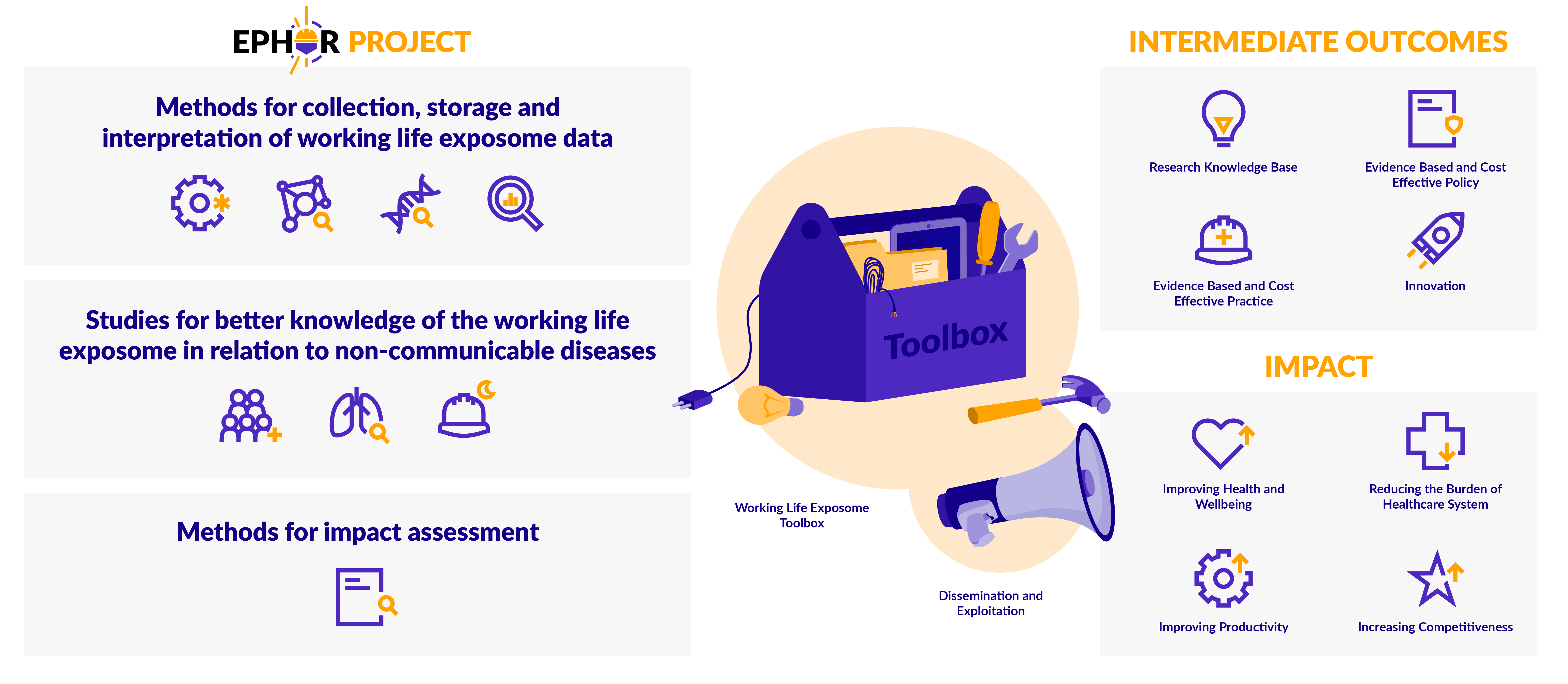
The EPHOR project (Exposome Project for Health and Occupational Research) set out to transform how we understand and prevent work-related diseases in Europe. Many major illnesses—including cancer, cardiovascular disease, respiratory problems, and mental health conditions—can be linked to harmful exposures at work. Globally, an estimated 5–7% of all deaths are attributable to workplace exposures. Yet traditional occupational health research often examines one exposure at a time, even though workers experience multiple exposures simultaneously and throughout their working lives.
EPHOR applied the exposome concept—the totality of environmental exposures across life—to the occupational context. The project defined the working-life exposome as all workplace and related non-occupational exposures from early working life to old age. Its overall goal was to generate new knowledge, methods, and tools that help reduce the burden of work-related disease.
Work performed and Major Achievements
Building a European foundation for exposome research
EPHOR created the first comprehensive inventory of over 150 European cohorts with occupational histories, and a database of existing job exposure matrices. It also developed EuroJEM, a harmonized tool for assessing multiple workplace exposures using job titles, covering chemical, physical, ergonomic, psychosocial, and biological exposures. New methods were introduced to harmonize exposure data, assign job titles using AI and text mining, and analyze multiple exposures jointly.
Large-scale analyses of work-related health outcomes
Working groups on cancer, cardiometabolic, neurodegenerative, musculoskeletal, mental, and respiratory diseases identified research gaps and conducted 17 analyses across European cohorts. These included multi-exposure analyses, evaluation of exposure duration and timing, and assessments of vulnerable subgroups. New approaches for health impact assessment, including the use of working-life expectancy, were also developed.
Intensive exposome data collection in two case studies
EPHOR designed wearable sensor systems, environmental samplers, harmonized biological sampling protocols, and advanced bioinformatics workflows. These tools supported two in-depth case studies:
- Night shift work: Among 937 healthcare workers in four countries, the study showed that night shift work affects multiple biological systems—circadian rhythms, immune function, metabolism, gene expression—alongside sleep, fatigue, and psychosocial stress. These findings provide clear biological evidence for the health risks associated with night work.
- Respiratory health: In 146 workers with mild asthma, week-long exposome monitoring revealed regional differences in exposure profiles. Several exposures and combinations were linked with short-term changes in lung function, inflammation, proteomics, and VOCs.
Impact and wider societal implications
EPHOR has established the foundation for next-generation occupational health research in Europe. The project demonstrated how the exposome approach can be scaled to large cohorts and applied in detailed field studies. It has also trained a new cohort of researchers and influenced new European initiatives.
To support ongoing impact, the WE-EXPOSE Toolbox has been released, providing open access to methods, protocols, exposure data explorers, biomonitoring tools, and guidance for sensor-based exposure assessment. Co-created with occupational health stakeholders, it is designed for use by researchers, policymakers, and OSH professionals.
More information:
www.ephor-project.eu • www.we-expose.eu • www.humanexposome.eu
Jan 2020
Start
Jun 2025
End
20
partners
12
countries
Funding from the European Union’s Horizon 2020 research and innovation programme under grant agreement No 874703
Project management
TNO – Netherlands Organisation for Applied Scientific Research
PO Box 96829
The Hague
The Netherlands
Anjoeka Pronk
Project coordinator

Eelco Kuijpers
Co-coordinator and scientific support
Astrid Kruizinga
Project manager
External scientific advisory board

Heidi Beate Bentzen
University of Oslo

Laura Beane Freeman
US National Cancer Institute
Paolo Vineis
Imperial College London

Nick Warren
UK Health and Safety Executive